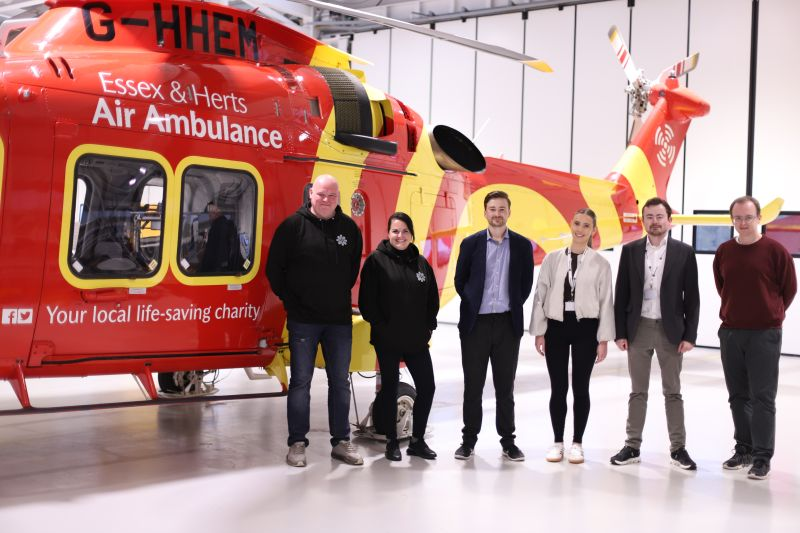
Mission: Critical – Life-Saving Lessons with Essex & Herts Air Ambulance
16/10/2025 • Tony Brown
Still buzzing from Mission: Critical at North Weald with Essex & Herts Air Ambulance (EHAAT) yesterday evening. A proper eye-opener that knocked a few misconceptions into touch – from what good CPR actually looks like to why nobody should be afraid of a defibrillator, plus what to do (and not do) when you're first on scene at an RTA.
This wasn't just another training session. It was an immersive experience that brought together business leaders, local entrepreneurs, and community members to learn potentially life-saving skills from the experts who deliver critical care every single day.
Five Big Takeaways
1. Early Actions Save Lives – Quality CPR is Hard, Fast, and Relentless
One of the biggest misconceptions about CPR is what "good" CPR actually looks like.
The truth? It's physically demanding. You need to push hard and fast – at least 5-6cm deep at a rate of 100-120 compressions per minute. That's the tempo of "Stayin' Alive" by the Bee Gees (appropriately named).
What the team at EHAAT made crystal clear: early CPR dramatically increases survival rates. Every minute without CPR reduces the chance of survival by about 10%. But effective CPR can double or even triple a person's chance of survival.
The key lessons:
- Push hard, push fast – don't be afraid to use your body weight
- Minimize interruptions – continuous compressions are critical
- Don't stop – keep going until help arrives or you're physically unable to continue
- Tag team if possible – CPR is exhausting, switch every 2 minutes if you can
Most importantly: imperfect CPR is better than no CPR. Don't let fear of "doing it wrong" stop you from acting.
2. Defibrillators Are There to Help – They Guide You Step-by-Step
Hands up if you've walked past a defibrillator and thought "I wouldn't know how to use that"?
You're not alone. But here's what we learned: defibrillators are designed for anyone to use, regardless of training.
Modern automated external defibrillators (AEDs) literally talk you through the process:
1. Turn it on
2. Follow the voice instructions
3. Attach the pads as shown in the diagram
4. The machine analyzes the heart rhythm automatically
5. If a shock is needed, it tells you exactly what to do
6. You cannot "accidentally" shock someone – the device only advises a shock if it's needed
The biggest barrier isn't the technology – it's confidence. And that confidence comes from understanding that:
- You cannot make things worse – if someone is in cardiac arrest, they're already in the worst possible state
- The defib will not shock unnecessarily – it only advises a shock if the heart rhythm indicates it's needed
- It's safe – you cannot harm yourself or others if you follow the instructions
3. Scene Safety + Clear Info to 999 Matters As Much As Speed
When you're first on scene at a road traffic accident (RTA) or medical emergency, your instinct is to rush in and help. But the EHAAT team emphasized something crucial:
You can't help if you become a casualty yourself.
The priorities at any emergency scene:
1. Ensure your own safety first – assess hazards (traffic, fire, chemicals, etc.)
2. Call 999 immediately – don't assume someone else has done it
3. Provide clear, specific information:
- Exact location (road names, landmarks, what3words if you have it)
- Number of casualties
- Nature of injuries or condition
- Any immediate dangers (fire, fuel leak, live wires)
4. Only then provide assistance – within your capability and safety limits
The quality of information you provide to 999 directly impacts:
- Which resources are dispatched
- How quickly they can locate you
- What equipment they bring
- Whether air ambulance is deployed
Clear communication saves time. And in emergencies, time saves lives.
4. The Crew's Prep, Roles, and Comms Are Razor-Sharp to Launch in Minutes
One of the most impressive parts of the evening was seeing behind the scenes at EHAAT's operations.
When a call comes in, the team can be airborne in under 4 minutes.
How? Through:
- Meticulous preparation – aircraft and equipment are constantly maintained and ready
- Clear role definition – every crew member knows exactly what they need to do
- Flawless communication – between control, pilots, and medical crew
- Continuous training – the team trains relentlessly for every scenario
What struck me most was the professionalism and precision. There's no room for ambiguity or confusion. Lives depend on split-second decisions and flawless execution.
It's a masterclass in operational excellence that any business can learn from:
- Clear processes and procedures
- Well-defined roles and responsibilities
- Effective communication protocols
- Commitment to continuous improvement
- Team cohesion and trust
5. The Wider Team (Ops, Patient/Family Support, and Fundraising) is Incredible
Here's something many people don't realize: Essex & Herts Air Ambulance receives no government funding for its daily missions.
Every flight, every piece of equipment, every crew member is funded by charitable donations. It costs approximately £1 million per month to keep the service operational.
But it's not just about the flying. The organization provides:
- 24/7 critical care – bringing hospital-level treatment to the scene
- Patient and family support – ongoing care and counseling after incidents
- Community education – teaching life-saving skills across Essex and Hertfordshire
- Collaboration with other emergency services – seamlessly working with ambulance, fire, and police
The dedication of the entire team – from pilots and paramedics to fundraisers and volunteers – is truly humbling.
Community and Connection
It was fantastic to team up with Stacey and connect with our good friends Luke, Joe, Madeleine, and Jack from &Element, and to bump into our neighbors FSE Digital – lovely to see founder Danny, Sarah, Mae, Grace, and the rest of the team too.
Events like Mission: Critical aren't just about learning skills. They're about bringing the business community together, building connections, and collectively supporting the incredible organizations that keep us safe.
A Huge Thank You
A massive thank you to Lyndsay Wood, Stacey-Louise Wilson, the fundraising team, the volunteers, the crews, and everyone else at Essex & Herts Air Ambulance for the learning and for the life-saving work you do every day.
Your professionalism, dedication, and commitment to the community is extraordinary.
Take Action
If you get the chance to participate in Mission: Critical or any other EHAAT experience, take it. The skills you learn could genuinely save a life.
And if you can, please support them:
- Donate: Every contribution directly funds life-saving missions
- Volunteer: Help with fundraising, events, or community outreach
- Spread awareness: Share their work and encourage others to support
- Book a corporate experience: Bring your team for an unforgettable learning opportunity
Visit Essex & Herts Air Ambulance to learn more about their work and how you can help.
The Bigger Picture
Beyond the practical skills, evenings like this remind us of something important:
We're all part of a community. And sometimes, being part of that community means being ready to step up when someone needs help.
You might never need to perform CPR. You might never be first on scene at an accident. But if that moment comes, you'll be glad you learned what to do.
And you might just save a life.
---
Interested in organizing a corporate first aid training session or health & safety review for your business? Get in touch →